Craft & culture
Ajrak: the indigo-and-red cloth of Sindh, and how to tell a real one
Deep indigo, madder red, and a pattern printed on both sides. Here is how ajrak is made, how Sindhis wear it, and how to tell a hand-blocked piece from a screen print.
Some links in this guide are commission links: if you buy, we may earn a small fee at no cost to you. How we earn.
In this guide
Walk into a Sindhi wedding, a village guest room or a Sufi shrine and you will see it: a long cloth in deep blue and crimson, printed with a pattern so dense and exact that it looks woven. It sits on shoulders, it is wrapped around a bridegroom, and it is offered to a guest as a mark of respect. That cloth is ajrak, and it is the closest thing Sindh has to a flag you can wear.
If you have seen the pattern on a scarf or a cushion and wondered what it is, or you are thinking of buying one, this is the guide.
What is ajrak?
Ajrak is a cotton cloth that is block-printed by hand, on both sides, using resist dyeing. Wooden blocks stamp a protective paste onto the cloth, the cloth is dyed, and the paste keeps the dye out of the printed areas. Repeat that with several blocks and several dye baths and you get the classic look: indigo blue, madder red, black and white, in a tight lattice of stars, medallions and borders.
Where the name comes from is debated. One theory links it to a word for blue, which suits the indigo vat at the heart of the craft. Another reads it as a phrase meaning “keep it for today”, a nod to the patience the cloth demands, since it rests for days between stages.
How old is it?
Very old, if the makers are to be believed. Textile researchers note that resist-dyed cloth in indigo and madder is closely tied to the Indus valley, where archaeologists found a dyers’ workshop at Mohenjo-daro. Ajrak printers say that the trefoil pattern on the shawl of the famous “Priest-King” statue from that city is the same cloud pattern, called kakar, that they still print today.
That is a craft tradition, not a proven line of descent, but it explains why Sindhis treat ajrak as heritage rather than fashion. It is also closely associated with Sufi shrines in Sindh.
How it is made
Accounts of the process count anything from about fourteen to twenty-two separate stages, depending on who is counting and what they include. In outline:
- The cloth is washed and prepared so it takes dye evenly.
- A first resist is printed. A paste of lime, gum and clay is stamped on with carved wooden blocks. After dyeing, this leaves the white outlines of the pattern.
- A second resist and a mordant are printed, often dusted with a fine powder such as ground rice husk.
- The cloth goes into the indigo vat. It comes out pale and turns blue as the air reaches it.
- It is washed and printed again with the red areas, where madder (the source of alizarin) and alum produce the crimson.
- A last wash removes the resist and any spare dye, and the finished pattern appears.
Every colour needs its own block, and each block has to land exactly on the last print. The printer then does the same on the back of the cloth, so that the pattern lines up on both sides. One cloth can take from about ten days to three weeks, depending on the design.
Reading the cloth
The classic ajrak has a central field of repeating geometric shapes, a band of border on each long edge, and panels at each end. You will also hear names for variations on the classic theme, such as teli, sabuni, do rangi and kori ajrak.
You do not need to decode the motifs to enjoy it. Treat any seller who claims to give a precise meaning for every shape with a little caution. The patterns are traditional, and their stories vary from family to family.
How to tell a hand-blocked ajrak
Prices vary enormously, and the cheap end is usually not made the traditional way. Screen-printed and digitally printed “ajrak designs” are common and sold at a fraction of the price. They are not frauds if they are described honestly, but they are a different product. To check:
- Turn it over. A genuine hand-blocked piece shows the pattern with almost equal strength on the back. A print that is bold on the front and faded on the back is a surface print.
- Look at the edges of the shapes. Hand blocks leave small, human irregularities where one stamp meets the next. A perfectly crisp, identical repeat can mean a machine.
- Feel and smell. Natural-dyed cloth usually has a slightly earthy smell and a softer hand than stiff, glossy prints.
- Ask what it is. A good seller will say whether it is hand-blocked, whether the dyes are natural or synthetic, and where it was made.
- Think about the price. Days of skilled work cannot be sold for the price of a scarf at a market stall.
How Sindhis wear it
Men and women wear it over the shoulder as a shawl, and men fold it as a turban or tie it around the waist. In Sindh it is paired with the embroidered mirror-work Sindhi topi, and the two together are the dress of Sindhi Culture Day, celebrated in early December, when whole towns turn out in blue and red.
Outside Sindh, ajrak works as a bedspread, a throw over a sofa, a table runner, a curtain, or a length cut into a kurta or dupatta. Many Sindhi families also keep an old ajrak as the backing of a patchwork quilt.
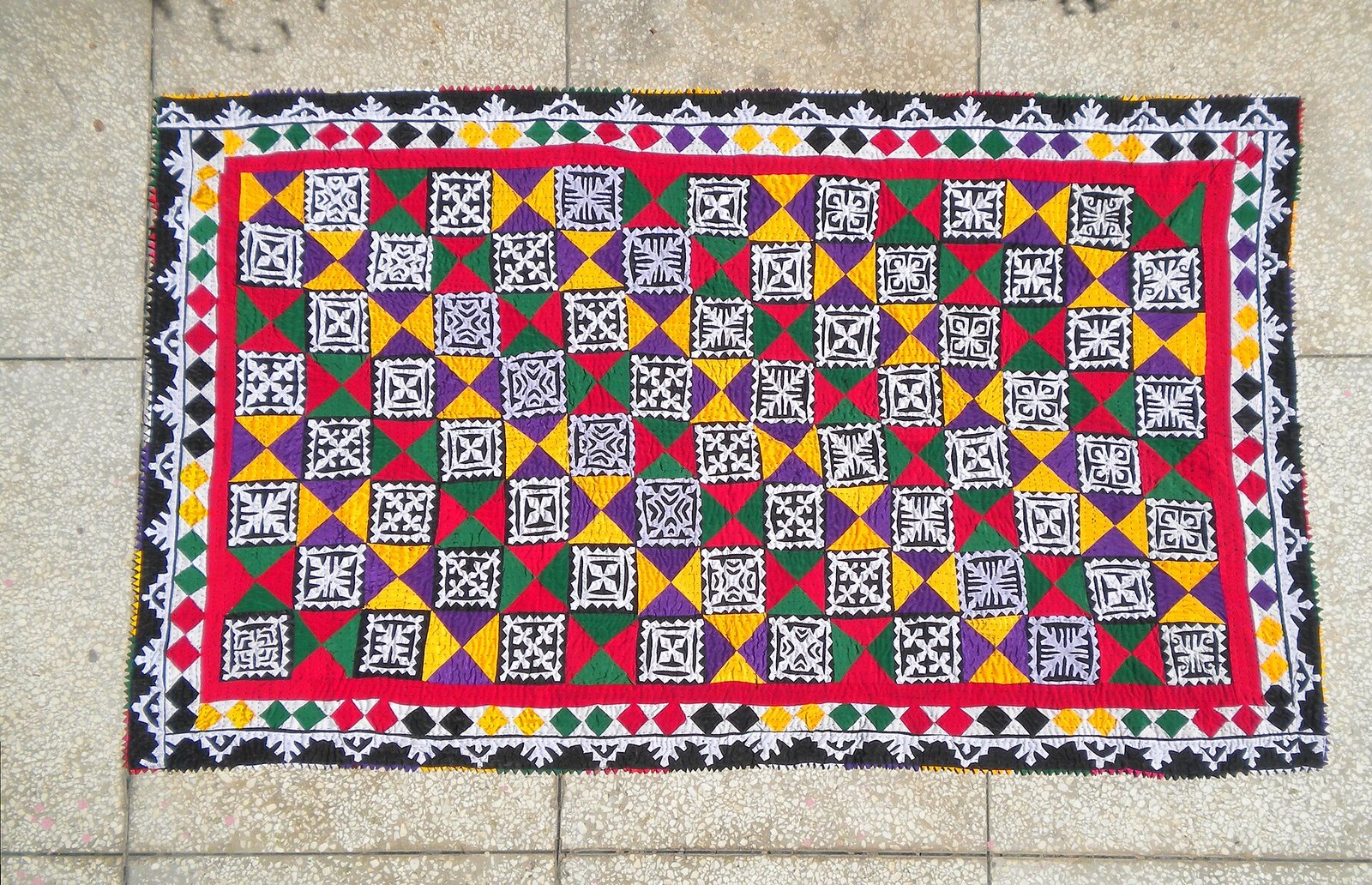
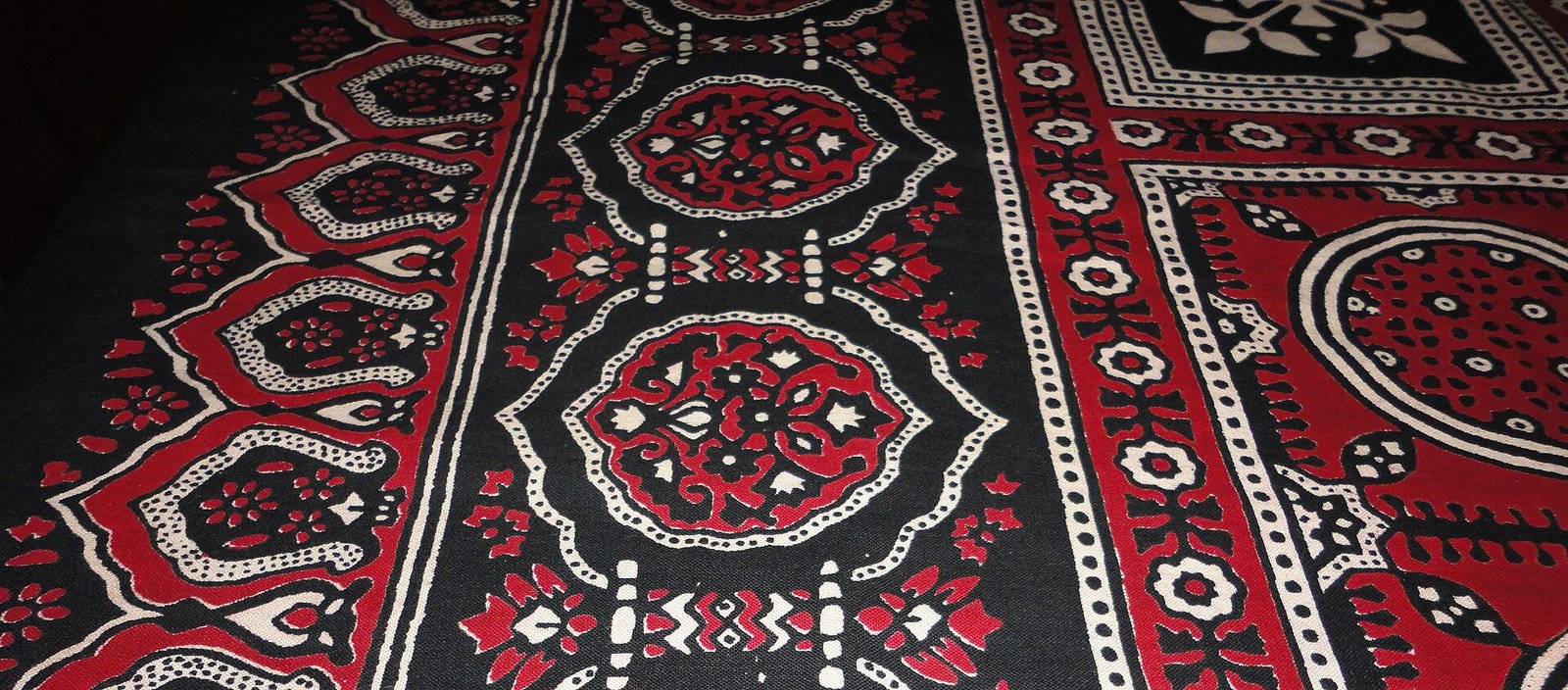 Photo: Ahub1988The real thing
Ajrakاجرک
Block-printed cotton shawl
Indigo and madder, stamped by hand on both sides of the cloth.
Sindhi topiسندھی ٹوپی
Embroidered mirror-work cap
A round cap covered in mirrors, with an arch cut out at the front.
Washing and care
Hand-blocked cloth dyed with natural dyes can release a little colour in its first washes, which is normal. To keep it looking its best:
- Wash it separately in cold water, with a mild detergent and no bleach.
- Do not soak it for long, and rinse until the water runs clear.
- Dry it in the shade, and iron it on a medium setting while still slightly damp.
- If the seller has given care instructions, follow those first.
Buying ajrak
If you want an authentic piece, look for a seller who names the makers or the town, shows the back of the cloth in their photos, and describes the dyes. For a gift that lasts, a shawl is hard to beat: it is useful, light to pack and rooted in one place. You will find more ideas in our guide to gifts from Pakistan.
If you like truck-art colours more than indigo, read how Pakistan’s painted trucks got their look in our truck art guide.
Questions people ask
What does ajrak mean?
The origin of the word is debated. One theory links it to a word for the colour blue, after the indigo dye. Another reads it as a phrase meaning “keep it for today”.
Is ajrak only from Sindh?
It is most closely associated with Sindh, Pakistan. Related block-printing traditions are practised in Kutch in Gujarat and Barmer in Rajasthan, where it is often spelled ajrakh.
How long does it take to make one ajrak?
By hand, anywhere from about ten days to three weeks, because the cloth is printed, dyed, washed and rested through many stages.
How do I know if an ajrak is hand-blocked?
Check the back: the pattern should show almost as clearly as on the front. Look for the small irregularities of hand stamping, and ask the seller about the printing method and the dyes.
Can I wash an ajrak?
Yes, usually by hand in cold water with a mild detergent, separately for the first few washes, and dried in the shade. Follow the seller’s care instructions if they gave any.