Food & drink
Sohan halwa: Multan’s winter sweet, and how to choose a good tin
Dense, chewy, glossy and packed with nuts, sohan halwa is one of Multan’s best-loved gifts. Here is how it is made, why it belongs to winter, and what to look for in a tin.
Some links in this guide are commission links: if you buy, we may earn a small fee at no cost to you. How we earn.
In this guide
Visit Multan and you will not leave without one. Every sweet shop in the old city sells it, stacked in flat tin boxes by the till, and every traveller takes one home. It is a dark golden slab, glossy with ghee and studded with pistachios and almonds, and it is nothing like the soft, spoonable halwa you may know. This is sohan halwa.
Here is what it is, where it comes from, and how to choose a good one.
What is sohan halwa?
Sohan halwa is a dense, chewy sweet that you cut into pieces, more like a cross between caramel and nougat than a pudding. The ingredients are simple: a starch (wheat, or in many modern recipes corn flour), milk or water, sugar, a great deal of ghee, and nuts, usually with cardamom or saffron.
What makes it hard is the cooking. The mixture is stirred over heat for hours without a break, and the sweet maker decides when to stop. Stop earlier and it is chewy and fudge-like. Cook it longer and it sets brittle and crumbly, a style known as papdi (or papri).
Recipes also differ in the starch. Old recipes call for sprouted wheat, which gives a deeper, slightly malty flavour. Many shops today use corn flour or refined flour, which is quicker and cheaper.
Why Multan?
An old Persian couplet lists the “gifts” of Multan as dust, heat, beggars and graveyards. Multanis today like to add two sweeter ones: sohan halwa and mangoes. One is a summer fruit, the other a winter sweet, and both are now the city’s trademark, as Dawn has noted. If you would like to know more about the fruit, see our guide to Pakistani mangoes.
Several other towns in southern Punjab make a name for their own versions, including Bahawalpur and Dera Ghazi Khan, but Multan’s remains the one everyone knows.
Where does the name come from?
Nobody knows for certain. The stories you will hear include:
- A milk seller called Sohan whose new sweet was named after him.
- A link to the Iranian city of Sohan, with the halwa travelling to Multan with traders.
- A word meaning to rub or stir, for the long work with the spoon.
These are folk stories rather than documented history. What is documented is that a sweet called halwa-i-suhan appears in Mughal-era cookbooks, including one written for the kitchen of Emperor Aurangzeb. Those recipes use sprouted wheat, ghee, sugar or honey, nuts and spices such as cardamom and nutmeg. So the sweet is older than any single shop in Multan.
A winter sweet
Sohan halwa is eaten year round, but it is a winter sweet at heart. It is rich and heavy, and it is the sort of thing you want with a hot cup of tea when the evenings turn cold. In many families a tin arrives as a gift when someone returns from Multan, and it is offered to guests with tea or kahwa.
How to choose a good tin
You can spend a lot on bad halwa, and a lot less on very good halwa. A few checks help:
- Read the ingredients. Look for ghee rather than vegetable oil or shortening, and a short list. Real ghee and plenty of nuts cost more, so the cheapest tin is rarely the best.
- Look at the slab. It should be glossy and cut cleanly, with nuts through it, not a pool of oil in the bottom of the box.
- Taste a piece if you can. Good sohan halwa is chewy, caramel-brown and balanced, rather than sugary and gluey.
- Pick your nuts. Almond and pistachio are classic, and walnut and cashew versions are common in Multan.
- Choose a known maker. Long-established Multan shops sell the same style for decades. Hafiz Multani Halwa, for example, has been making it for over eighty years, according to Google Arts & Culture.
Check the best-before date on the tin, and keep it somewhere cool and dry. Sohan halwa keeps well, but in a warm kitchen it is better refrigerated, then brought back to room temperature before serving so it is chewy again.
How to serve it
Cut it into small squares, as it is very rich and a little goes a long way. Serve it with strong tea, like our Pakistani doodh patti chai, or with plain green tea with cardamom.
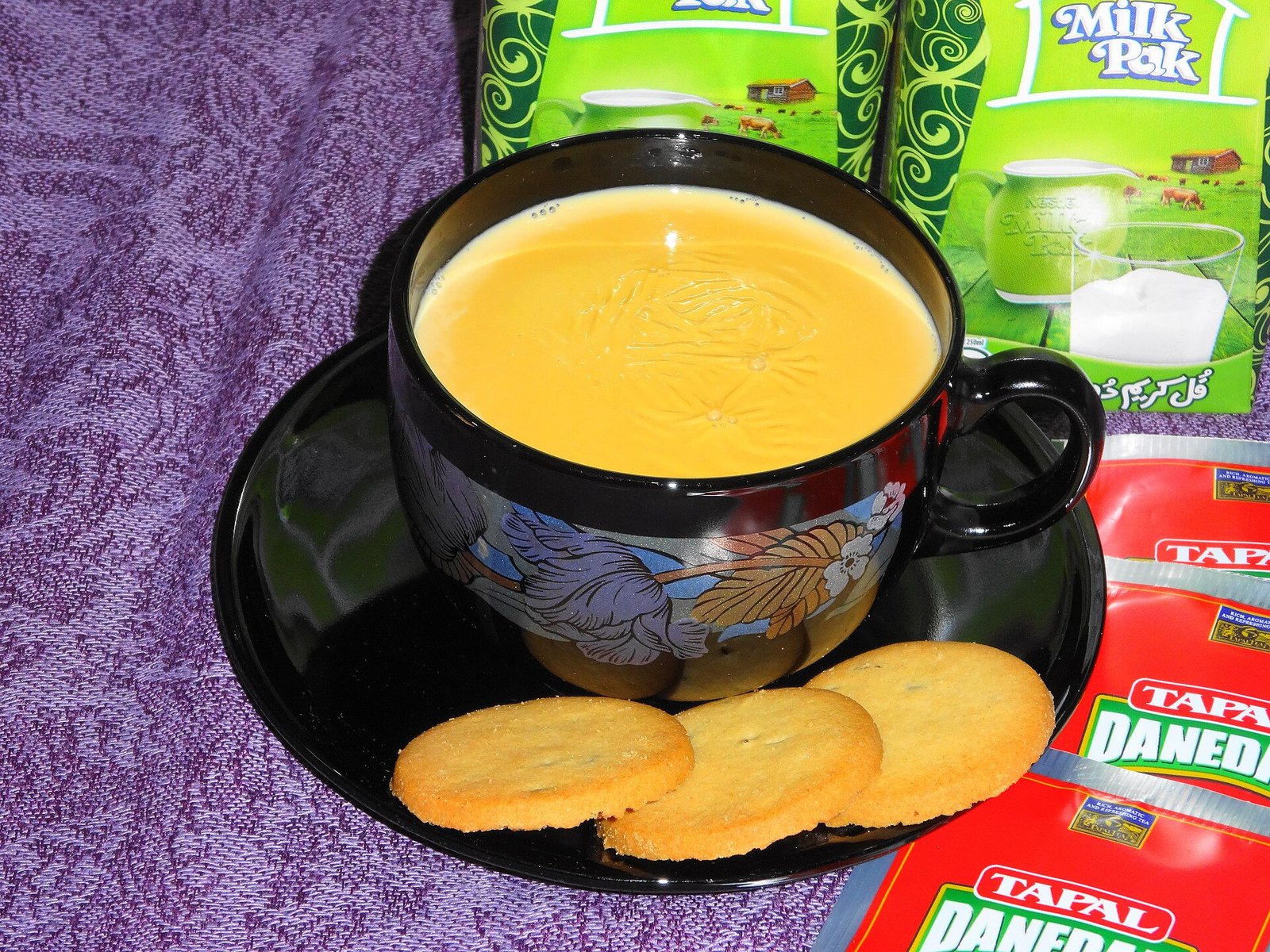 Photo: Miansari66The real thing
Tapal Danedarدودھ پتی
Strong black tea for milky Pakistani chai
The strong, granular tea behind Pakistan’s milky, sugary doodh patti.
Kahwa green teaقہوہ
Green tea with cardamom
Green tea with cardamom, poured in Peshawar’s Storytellers’ Bazaar.
Other halwas to try
Pakistan has a lot of halwas, and they are quite different from one another. Gajar ka halwa is soft, made from grated carrot, and is another winter sweet. Habshi halwa is dark brown and milk-rich, cooked from sprouted wheat, ghee and spices. And the Sunday breakfast of halwa puri is a different dish again, a soft semolina halwa with fried bread and chickpea curry. If you give sohan halwa as a gift, one of those might be the surprise at the next visit.
For more ideas, see our guide to gifts from Pakistan.
Questions people ask
What is sohan halwa made of?
A starch such as wheat or corn flour, milk or water, sugar, plenty of ghee and nuts, usually with cardamom or saffron. Older recipes use sprouted wheat.
Is sohan halwa vegetarian?
Traditional recipes use ghee and often milk, so it is vegetarian but not vegan. Check the label on a tin, as recipes vary.
Why is it called sohan halwa?
The origin is uncertain. Stories include a milk seller named Sohan, a link to an Iranian city, or a word for stirring. None is proven, and halwa-i-suhan appears in Mughal-era cookbooks.
Is sohan halwa only eaten in winter?
No, it is eaten all year, but it is especially popular in the cold months because it is so rich.
How long does sohan halwa last?
It keeps for a long time compared with most sweets, but follow the best-before date on the tin, keep it cool and dry, and refrigerate it in a hot climate.